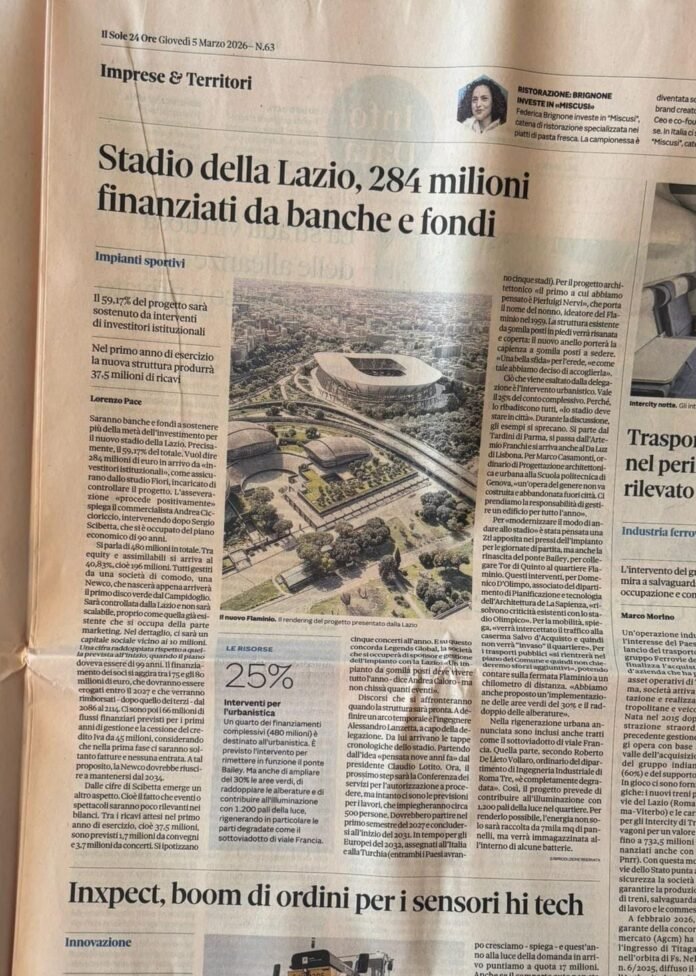

We asked Artificial Intelligence to analyse the Sole 24 Ore article about the Flaminio and explain why it is so difficult to realise:
The project envisages a total investment of €480 million, of which €284 million (59.17%) covered by banks and funds — institutional investors. The remaining 40.83% would be managed by a Newco controlled by Lazio, with share capital of just €10 million and a shareholder contribution of between €75 and €80 million.
Three aspects make this financial structure delicate:
- Very long-term repayment: shareholder loans would be repaid between 2086 and 2114, a timeline no private investor considers “normal”. It is a model that requires total faith in the club’s stability and management continuity for almost a century.
- Limited revenues: first-year revenues are estimated at €37.5 million, but only €1.7 million from conferences and €3.7 million from concerts. Non-football events, which are often the decisive economic lever for modern stadiums, carry marginal weight here.
- Negative initial cash flows: in the early years there will be no income, only invoices, offset by €66 million in cash flows and the assignment of €45 million in VAT credits. It is an uphill start.
In summary: the project rests on a very fine balance between debt, investor confidence, and the club’s ability to guarantee stability for decades.
The urban planning knot: 25% of the budget is for the city, not the stadium
A quarter of the total investment — around €120 million — is earmarked for urban regeneration: restricted traffic zones, a Bailey bridge, lighting with 1,200 new lamp posts, green spaces increased by 30%, and regeneration of degraded areas.
This means two things:
- The project is not just a stadium, but a complex urban intervention involving mobility, safety, infrastructure, and public spaces.
- Each element requires authorisations, opinions, constraints, and approvals from different bodies.
And this is where the real obstacle lies.
The Services Conference: the most difficult hurdle
The next step is the Services Conference, which must give the definitive green light. This is a notoriously long process, especially when:
- the area is protected (the Flaminio is a Nervi work, under heritage protection);
- the project involves deep structural modifications;
- it involves the Municipality, Superintendency, Region, Fire Brigade, mobility bodies, and environmental agencies.
Every body can request additions, modifications, revisions. Every revision can push the timeline back.
The timeline: an optimistic schedule
The goal is to start construction in 2027 and complete it in 2031, in time for Euro 2032. But:
- the Flaminio is a historic stadium, with complex architectural constraints;
- urban regeneration requires multiple, coordinated contracts;
- the Newco will only be created after Campidoglio approval, so it does not yet exist.
Every delay in the Services Conference pushes everything back.
Why it is a difficult project to realise
- Fragile financial model, based on very long-term debt and revenues that are not particularly robust.
- Dependence on institutional investors, who may revise their commitment in the event of economic or political instability.
- Architectural and urban planning constraints that make every modification complex and subject to multiple opinions.
- A long and uncertain approval process, with the Services Conference as the real stumbling block.
- Very optimistic timelines, difficult to keep to in such a complex context.
- Absence of an operational Newco, which makes the project still “virtual”.
The project is fascinating and potentially transformative for the Flaminio neighbourhood, but its realisation requires a perfect alignment of finance, politics, urban planning, and timelines. And in the history of Italian stadiums, this alignment has always been rare.