
Introduction
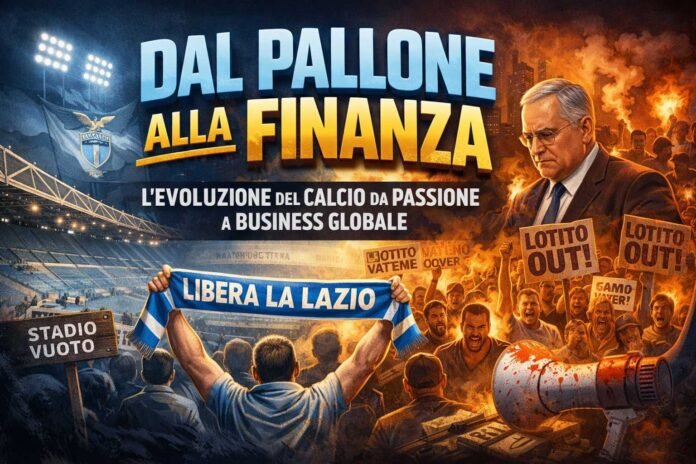
Football is no longer the game of local rivalries and Sundays on the terraces: it's a global business, a billion-dollar industry that has left pure passion behind to chase spotlights, TV and balance sheets. This article attempts to draw a parallel between the central argument of Francesco Alfonsi's thesis "The Evolution of Football from Identity Sport to Global Business" – which explains how media, Bosman, FFP and international competitions have transformed the ball into a commercial product – and what is exploding today in the Lazio world under the Lotito management.
The protest of the organised ultras, with empty stadiums and extremely harsh statements, is not just terrace rage: it's the symptom of a model that is clashing with a football system that no longer forgives mere financial prudence. Let's see why.
Lazio between balance sheet and belonging
In contemporary football, economic solidity is often presented as an absolute virtue. It's a convenient reading, especially in an era in which the sector has become a global industry driven by TV rights, sponsors, international competitions and commercial positioning strategies. But the thesis from which this reflection starts clearly shows that the transformation of football has not only raised the economic level of the game: it has also accentuated inequalities, rewarding those who manage to stay inside the market without being overwhelmed and penalising those who remain outside the upper tier of sporting capital.
This is precisely where the Lazio case sits. Claudio Lotito's model is often described as an example of prudent management, capable of keeping the accounts in order and avoiding the risk of structural debt. On the surface, it seems the most rational response to a football that has lost its sense of limits. But if you look at it carefully, the Biancoceleste model does not appear as an alternative path to the system: it appears rather as a form of defensive adaptation to the system itself.
A sustainable, but not expansive club
Lotito's Lazio does not aim to grow through aggressive accumulation of capital, as the clubs chasing a global dimension do. It aims instead to protect itself, to stay within limits, to maximise what it can obtain without exposing the club to excessive imbalances. It's a strategy consistent with the context described by the thesis, in which football has turned into a product to be economically enhanced and in which financial sustainability has become a minimum condition for survival.
The problem is that this logic is not enough to produce a structural leap in quality. The contemporary football system is built on a very rigid hierarchy: at the top, resources, visibility and talent are concentrated, while the rest of the market moves within ever tighter margins. In this scenario, virtuous management can avoid collapse, but rarely produces a stable competitive advantage against clubs that are richer, more attractive to sponsors and broadcasters, and more integrated into the great trajectories of the football business.
The weak point of the model
The thesis helps to understand why the Lazio model cannot become a universal recipe. After Bosman, the player market opened up radically, strengthening the power of players and the strongest clubs; Financial Fair Play, born to rebalance the system, has often ended up consolidating the positions of those who already had solid economic foundations. In other words, modern football rewards not only those who manage well, but above all those who can afford to invest, attract, retain and develop talent in a circuit of continuous media exposure.
The Lotito model, then, has an evident limit: it's sustainable in terms of accounts, but it's not expansive on a sporting and symbolic level. It can guarantee balance, but it doesn't promise continuous ambition; it can preserve the club, but it doesn't always satisfy a fanbase that expects participation, competitiveness and vision. And it's in this gap between corporate logic and popular expectation that the protest of the organised ultras fits.
The protest of the organised ultras
The protest of the Lazio faithful deserting the stadium for 4 consecutive home matches, including the Coppa Italia semi-final against Atalanta, is not simple terrace polemic. It's a political act in the most concrete sense of the term: a refusal to recognise as legitimate a management model perceived as distant, closed and incapable of sharing a credible perspective with the people.
The protest isn't just about results. It's about the way the club communicates, decides, represents the future and interprets its own social role. The statement from the organised ultras insists, in fact, on a feeling of exclusion: the fans feel called upon only when they are needed as a backdrop, but not involved when it comes to truly planning the club, the stadium or the relationship with the city. This explains why the dissent has taken on such a harsh tone precisely while talking about Flaminio and a Lazio that would like to imagine itself as more modern and asset-rich.
The Flaminio knot
The stadium project is also a key passage for reading the current tension. Lotito has presented Flaminio as a founding element of a new phase, with significant investments and a management model more similar to that of the great European stadiums. But for a substantial part of us fans, this prospect does not respond to a real demand for community: it risks, on the contrary, appearing as yet another announcement imposed from above, disconnected from the daily life of the support and from the demand for a stronger team immediately.
The thesis shows that modern football is increasingly oriented towards infrastructure, branding and asset enhancement. Yet, precisely in this passage, the Lazio case reveals the limit of the model: if the construction of the future is perceived as incompatible with the sporting present, the project loses consensus and fails to produce that collective legitimacy indispensable in a club that also lives on belonging.
The real political point
The Lotito model does not fail because it is irrational on an economic level. It fails, if anything, because it moves on a different plane from the emotional and identity-based one of the fans, while the football described by the thesis has never ceased to be also a symbolic product, sold and consumed through emotion, belonging and visibility. If the club limits itself to being efficient, but does not appear ambitious, the relationship with the fanbase deteriorates rapidly.
This is why the protest of the organised ultras is so significant: it's not just a challenge to Lotito, but a challenge to the paradigm that puts the balance sheet before the sporting experience. And in this sense, Lazio becomes an emblematic case of contemporary football: a club that manages to stay in the system, but which precisely for this reason reveals all its internal tensions.
Primary sources
Thesis "The Evolution of Football from Identity Sport to Global Business" by Francesco Alfonsi. Central source for the theoretical argument on media, Bosman, FFP, international competitions. https://tesi.luiss.it/42576/1/265531_ALFONSI_FRANCESCO.pdf
Journalistic sources (from web research, March 2026)
Corriere dello Sport: "Lazio-Milan, the choice of the organised ultras" (9 March 2026). Partial return to the stadium.
Lazialita.com: "Lazio, the protest of the organised ultras continues" (17 February 2026). Official statement.
SoloLazio.it: "The harsh statement of the organised ultras against the club" (4 March 2026).
TheLaziali.com: "Lazio Ultras Announce One-Off Return Against AC Milan" (9 March 2026).
Corriere dello Sport: "Lazio, the new statement from the fans" (5 March 2026).
Other contextual sources
Lazionews.eu: articles on the Flaminio project and Lotito investments (February 2026).