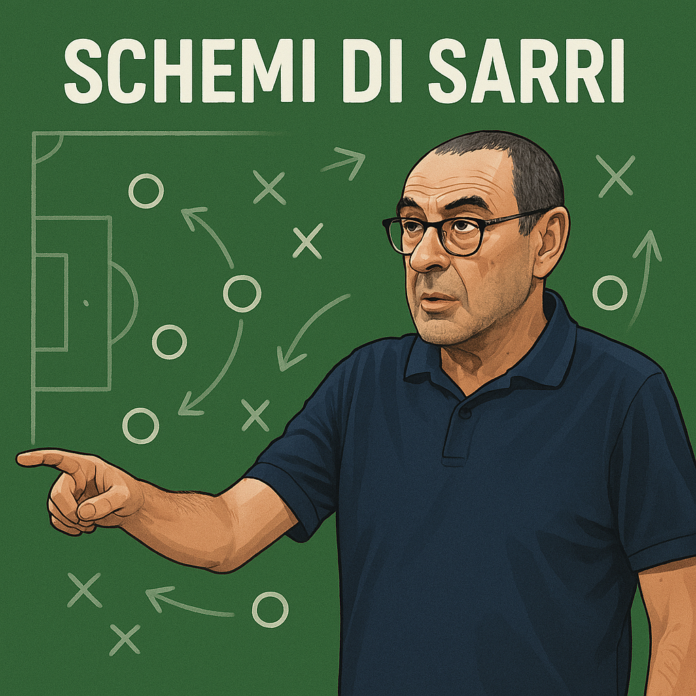

Maurizio Sarri's 4-3-3 is one of the most recognisable playing systems in modern football: a formation that becomes a method, a structure that becomes a language. Its strength lies not in the numerical layout, but in its principles: synchronisation, rational occupation of spaces, codified triangulations, organised pressing and an almost obsessive quest for positional superiority. Sources confirm that Sarri has built over 525 consecutive matches on this framework between Empoli, Napoli, Chelsea, Juventus and Lazio.
🧩 Identity of Sarri's 4-3-3
The system is founded on several cornerstones:
Back four with build-up from the back, even under pressure.
Deep-lying playmaker (from Valdifiori to Jorginho, from Leiva to Cataldi) as the technical and mental pivot.
Two dynamic box-to-box midfielders: one more creative (Hamsík, Luis Alberto), one more physical and vertical (Allan, Milinković-Savić).
Offensive trident with wide wingers and a striker who links play or attacks depth.
Lateral chains: full-back–midfielder–winger that create continuous triangles.
Organised pressing that directs the opponent's play towards predetermined zones.
High tempo and short passing, with preferential development on the chosen flank.
Current Lazio, for example, alternates in the non-possession phase between a 4-1-4-1 and, at times, a 4-2-4 thanks to the advancement of the physical midfielder and the dropping deep of the technical attacking midfielder.
🧬 The Historical Roots of the "Sarrista" 4-3-3
The 4-3-3 was not born with Sarri: it is a formation with a long and complex genealogy. Sarri inherits its structure, but reinvents it through modern principles.
1) The Holland of Michels and Cruijff (1970s)
Total football is born: pressing, positional interchanges, extremely high full-backs.
The 4-3-3 becomes the formation of fluidity.
Sarri picks up the idea of a short, synchronised team, while maintaining more defined roles.
2) Sacchi's Milan (1980s-90s)
Collective pressing, high defensive line, synchronised movements.
Sacchi's 4-4-2 influences Sarri in the phase without the ball: distances, aggression, a unit that moves as a block.
3) Cruijff's and then Guardiola's Barcelona (2000s)
Possession as a tool to control the tempo.
Triangulations, full-backs moving inside, quest for positional superiority.
Sarri does not copy Barça, but assimilates its logic: the ball as a means to organise the team.
4) The Italian school of possession football (Zeman, Spalletti, Montella)
Verticality, width, codified attacks.
Sarri takes all this to a level of almost "industrial" precision.
🔧 The Evolution of the 4-3-3 in Sarri's Career
Empoli: the laboratory
In 2012-13 he experiments with various formations (4-4-2, 4-2-3-1, 3-4-1-2), then finds in the 4-3-1-2 his first stable identity. From there, his tactical framework is born, which will evolve into the 4-3-3 at Napoli.
Napoli: aesthetic perfection
The 4-3-3 becomes a trademark.
Tight triangles, lateral chains, high pressing.
Mertens reinvented as a false nine, Hamsík as a late-arriving midfielder.
"Sarrismo" becomes a European model.
Chelsea: adaptation and confirmations
Wins the Europa League 2019.
Maintains the 4-3-3, adapting it to the Premier League: more physicality, less intricate possession.
Juventus: attempt at 4-3-1-2, return to 4-3-3
Tries to enhance Ronaldo and Higuaín with a diamond midfield.
Soon returns to the 4-3-3, more compatible with his principles.
Lazio: continuity and new challenges
Maintains the 4-3-3 as a base, with 4-1-4-1 and 4-2-4 variants in the offensive phase.
Currently also evaluating 4-4-2 or 4-2-3-1 for squad needs, marking a possible turning point after 13 years of loyalty to the system.
🧭 Modern Derivations of Sarri's 4-3-3
His 4-3-3 has generated a series of tactical "derivatives":
4-1-4-1: used in the non-possession phase to better cover width.
4-2-4: when the midfielder pushes up onto the line of the wingers.
4-2-3-1: possible current evolution, with a double pivot and a free attacking midfielder.
4-3-1-2: his Empoli root, useful when pure wingers are lacking.
3-4-3 in build-up: full-back tucking in to create a back three.
These variants are not "new" formations, but dynamic transformations that emerge based on the phases of play.
🏁 Why Sarri's 4-3-3 is Unique
Three elements distinguish it:
Extreme codification: every movement has a logic, every pass a direction.
Aesthetics of the game: it is not only effective, it is designed to be beautiful.
Absolute coherence: 525 consecutive matches with the same framework are no accident.
His 4-3-3 is a bridge between the tradition of total football, Sacchi's discipline and positional modernity.