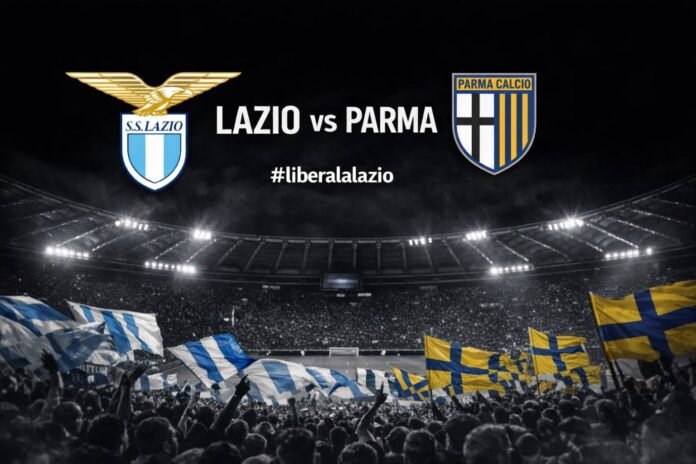

The clash between Lazio and Parma presents itself as a classic encounter between two opposing identities.
On one side a Lazio that, especially after recent changes, has accentuated its verticality and search for depth. On the other, an organised, compact Parma that bases much of its solidity on an orderly defensive phase and rapid transitions.
The general theme of the match is clear: management of rhythm versus the ability to spoil the game.
The home-field factor (without the crowd)
Making the context even more particular is the absence of the Lazio fans.
Playing at home without your own crowd profoundly changes the dynamics of the match: the emotional drive in key moments is reduced, the pressure on the opponent drops and it becomes harder to raise the rhythm and intensity continuously.
For a team like Lazio, which tends to build its dominance also through phases of pressure and emotional inertia, this can represent a limitation.
Conversely, Parma can benefit from a more "neutral" environment: less pressure in defensive phases, greater clarity in maintaining the low block and more ease in slowing down the tempo.
In this sense, the home-field factor risks being attenuated, if not even overturned on a psychological level.
A match of rhythm
Lazio will try to dictate the game through possession and circulation, but the real key will be not so much ball control as the speed with which it is moved.
Against a low block like Parma's, in fact, slow possession risks becoming sterile. On the contrary, raising the tempo means stretching the defensive lines, creating spaces between midfield and defence and favouring off-the-ball runs.
Parma, for its part, will seek exactly the opposite, lowering the rhythm and closing central spaces to steer the match onto more controlled tracks.
Parma's defensive system
Parma's defensive structure is by now recognisable: back five, midfield four and high central density.
The objective is twofold: protect the penalty area and deny receptions between the lines.
It is not a team that presses forward continuously, but prefers to wait and maintain compactness. This approach often forces opponents to develop play on the flanks, where, however, Parma can slide across in an orderly fashion.
In this context, finding space centrally becomes extremely complex.
The Kenneth Taylor factor
And this is where Kenneth Taylor comes into play.
His performance against Bologna clearly showed the type of impact he can have: not only for the two goals scored, but for the way he occupied the area.
Taylor is an atypical midfielder in terms of characteristics: he attacks space continuously, reads the timing of runs well, and constantly moves between the lines.
In the attacking phase he becomes, in effect, an extra man in the final third.
The decisive duel: space against density
The match is decided in a very specific zone: between the midfield and defensive lines of Parma.
If Taylor manages to receive and move in that space, Lazio will certainly gain numerical superiority and increase their threat in the final metres. Consequently, it would force Parma to drop even deeper.
If, however, Parma manages to maintain short distances and screen that zone, Taylor would be pushed away from the area, so Lazio would lose central attacking presence and the play would certainly become more predictable.
It is a clash between an individual principle and a collective one.
The risk of transitions
Another key element concerns the transition phases.
With Taylor often high up to attack the area, Lazio may leave spaces behind the midfield. On winning the ball back, Parma will immediately try to play vertically, exploiting the speed of their wide players.
This dynamic can become decisive, especially in the moments when Lazio pushes with greater intensity.
In conclusion, Lazio-Parma is a match played on fine balances.
It is not just a question of possession versus defence, but of how and where space is created. Lazio's ability to raise the tempo and Parma's ability to maintain compactness will define the flow of the game.
In this context, even the absence of the crowd can have more influence than expected, making the match less emotionally driven and more favourable to those who want to control its rhythm.
And precisely for this reason, Kenneth Taylor represents the true decisive factor: if he can make an impact between the lines, Lazio can steer the match. Otherwise, Parma will have the weapons to stay in the game until the end.