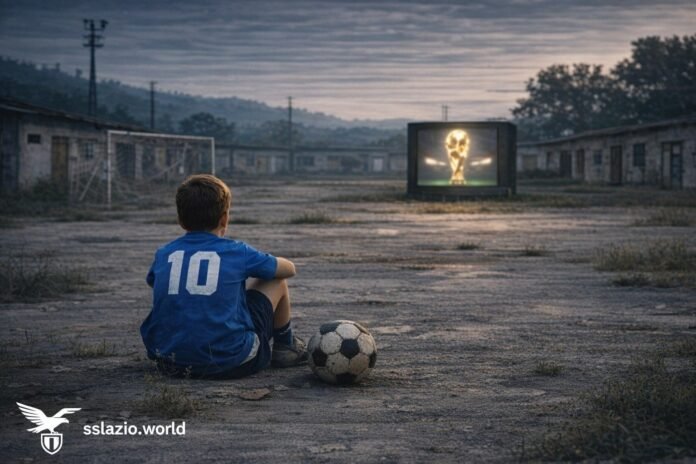

Italy will not take part in the World Cup: it is no longer just a possibility, but a snapshot of a country that since 2014 has seen its national team fail to qualify for the biggest international competition. Being out of the picture changes a lot: not just accounts and balance sheets, but also the way football is experienced by children, teenagers and families.
The generational void of those who have never seen "Italy at the World Cup"
Youngsters who are 16 years old today have never seen Italy play a World Cup. For them, the national game is a series of half-promises, an absent Azzurra, an image of disappointment rather than pride.
For many of these kids, the football was abandoned a long time ago: the streets filled with smartphones, video games and social media, while the pitch behind the house became an ever-emptier place. The World Cup is the event that, more than any other, manages to bring children back in front of the television and also out onto the pitch, but without the Nazionale involved, that "bridge" breaks.
The absence from three consecutive editions brings with it a weakening of the emotional bond between the country and the national game: the myth of "being a goalkeeper like Zoff", "a fantasista like Baggio", "a striker like Del Piero" loses its strength, and with it the motivation to sign up for a club, to endure training sessions, sacrifices, waiting on the bench.
Social impact on the territory
Football is one of the last vessels of social life for many small towns and suburbs: the local club is often the only place where kids and families meet, share, argue and find each other again.
With the Nazionale out of the World Cup for three cycles, the national story of football thins out: less space in the media, less passion in discussions at the bar and pizzeria, less "tension" towards the international dream. This reduces the narrative drive that pushes children to choose football over other activities, and increases the risk that football becomes a phenomenon for top clubs and collectors, rather than a mass education.
If the federation system does not truly change, the risk is that Italian football will become a movement weaker at its roots: fewer registered players, fewer healthy clubs, fewer active facilities, more spaces abandoned to decay and disuse.
Indirect economic impact on GDP
Football in Italy today generates around 6–7 billion euros in direct revenue (Serie A, professional game, FIGC, betting, media, merchandising) and an overall impact on GDP estimated at around 12–13 billion euros, i.e. roughly 0.5–0.6% of the national GDP.
This value is not just made up of player salaries and TV rights: the bulk of the indirect weight comes from:
Football tourism: cities that come alive for international matches, friendlies, Euros and above all World Cups, with hotels, restaurants, bars and transport recording peaks in activity.
Catering and domestic consumption: Azzurri evenings generate thousands of extra covers in bars, pizzerias, restaurants and pubs, as well as a sharp increase in spending on food, beers, snacks and drinks at home.
Media and advertising: the visibility of the Nazionale drives up audience ratings and advertising value; its absence reduces the viewer load and, consequently, the value of ad slots linked to the national game.
Local activities and facilities: when the Nazionale is at the forefront, interest in amateur activities, use of facilities, sign-ups for courses and youth tournaments all increase.
Without the World Cup, these levers weaken: less media drive, less local enthusiasm, less seasonal employment linked to major events, less spin-off for small businesses and artisanal activities.
A system that can no longer hide its problems
If Italy does not take part in the World Cup, and does so for the third time in a row, the message reaching society is clear: Italian football is in structural difficulty, not just technical.
Without major changes in the Federation — more transparency, more meritocracy, more investment in the youth sector, more attention to the territory and less politicisation — the risk is that Italian football becomes a fragile system: rich on the surface, but with few real roots.
We dream of Baggio in place of Gravina. Not literally, of course, but as a symbol: a football that goes back to being passion, ethics, a sense of belonging and quality, not just institutional storytelling.
An Italy that gives space to those who genuinely want to change the system, not to those who defend it because they profit or gain advantage from it. Because if football loses the heart of the suburbs, of the kickabouts, of the children who have never seen Italy at a World Cup, the bill to pay will be much heavier than hundreds of millions of euros lost.