
Introduction
Over the weekend I discovered a very interesting study published in the Sports Economics Review by Arrondel, Gayant and Laslier, addressing a question that overturns many certainties of modern football:
"Does it make sense to pay the most passionate fans to come to the stadium?"
The answer, surprisingly, is yes.
And not out of romanticism, but out of economic logic.
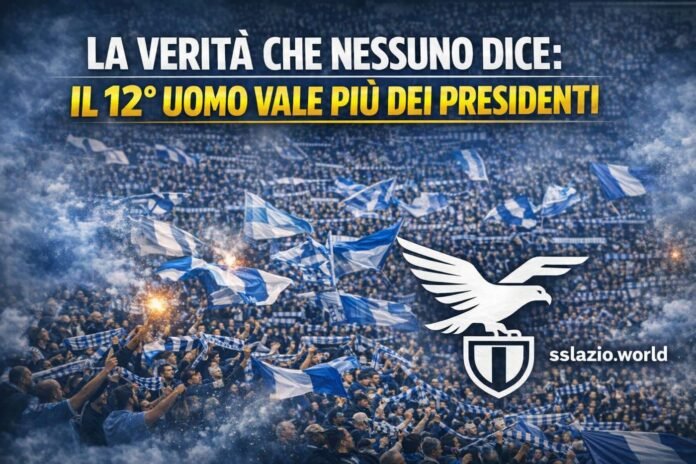
According to the paper, the ultras – the most demonstrative fans, those who create the atmosphere – directly increase the team's competitive level, improve sporting results and therefore boost revenues from TV rights.
In some cases, the theoretical model shows that the optimal ticket price can become zero or even negative: the club should subsidise the presence of the most passionate fans.
One sentence from the document is illuminating:
"Gli ultras contribuiscono al livello competitivo del club insieme al talento della squadra, e quindi indirettamente aumentano il numero di vittorie."
"The ultras contribute to the competitive level of the club along with team-level talent, and therefore indirectly increase the number of victories, hence the revenue from TV rights."
Now, try reading these conclusions in light of the "Libera la Lazio" protest.
The contrast is deafening.
The Lazio paradox: when economic theory says one thing and the president does the opposite
The protest is born from a widespread feeling:
the club does not value, does not listen to and often hinders the organised ultras, treating them as a problem rather than as a strategic asset.
And yet, according to the paper, the ultras are a productive factor in sporting success.
Not a cost.
Not a nuisance.
An investment.
1. Atmosphere is competitive capital
The paper states that the atmosphere generated by the fans is an integral part of the "production" of the sporting result:
"Le partite sono una produzione congiunta di tre attori: le due squadre e i tifosi."
"Matches are a joint production of three actors: the two teams and the fans."
Lazio, on the other hand, has for years experienced a fracture between the Curva and the president that weakens precisely this capital.
2. High prices = fewer ultras = less competitiveness
The model shows that raising prices drives away the most demonstrative fans, reducing the 12th man effect. Lotito even drives them away by waging war on them. Fans who have always been present despite the anti-popular policies constantly proposed by the current presidency.
3. Solidarity with the fans and journalists under attack: a battle lasting twenty years
The paper's most surprising result is clear:
"Il club potrebbe avere interesse a pagare i tifosi più dimostrativi."
"The club might have an interest in paying the most demonstrative fans."
Yet, while the economic literature recognises the strategic value of ultras, Lazio's recent history tells the exact opposite: a long, systematic and often brutal war against the organised support and against anyone who tries to narrate reality without filters.
A necessary solidarity
It is impossible not to express deep solidarity with all those who have suffered defamation, restrictions, media campaigns and denunciations.
This dynamic is not born today.
Its roots go back to 2006, when a season of open conflict began between the Lotito presidency and the world of the Irriducibili, with a series of battles that have marked an entire generation of fans: closures, repression, criminalisation of support, up to the progressive marginalisation of any form of organised dissent.
The Repubblica case: when the narrative becomes a tool
The latest episode – the article published in la Repubblica pointing the finger at a printing press defined as "anti-Lotito" – is a perfect example of how the narrative can become a weapon.
Why is the article problematic?
It confuses dissent and illegality, as if criticising a president were a subversive act.
It ignores twenty years of tension, reducing everything to a public order case.
It reinforces the rhetoric of the internal enemy, fuelling the idea that those who protest are automatically dangerous.
It embraces a one-sided version, without questioning the deep causes of the discontent.
It's journalism that doesn't illuminate: it obscures.
It doesn't explain: it simplifies.
And above all, it doesn't grasp the central point: dissent is not a crime. It's a right.
4. Clubs that aim for results lower prices
The paper's simulations show that the clubs most oriented towards victory lower prices, increase the atmosphere and accept lower box office profits to obtain more points and more TV rights.
Lazio, on the contrary, often seems to maximise immediate profit, not sporting performance.
5. The protest is rational, not emotional
The "Libera la Lazio" protest is not just an identity battle.
It is perfectly consistent with what the economic literature suggests:
a club that does not value organised support damages itself, its sporting results and its future revenues.
Conclusion: Lazio is a textbook case of managerial inefficiency
The paper closes with a sentence that seems written for Lazio:
"Sopra una certa soglia di diritti TV, può essere appropriato moltiplicare le iniziative gratuite o addirittura sovvenzionare la presenza dei tifosi più dimostrativi."
"Above a certain TV rights threshold, it may be appropriate to multiply free initiatives or even subsidise the presence of the most demonstrative fans."
And yet Lazio continues to treat the ultras as a problem.
The "Libera la Lazio" protest is not just a demand for dignity.
It's a demand for economic rationality.
It's the demand for a presidency that understands what economic science has now demonstrated:
without the 12th man, there is no competitiveness.
Without competitiveness, there is no growth.
Without growth, there is no future.