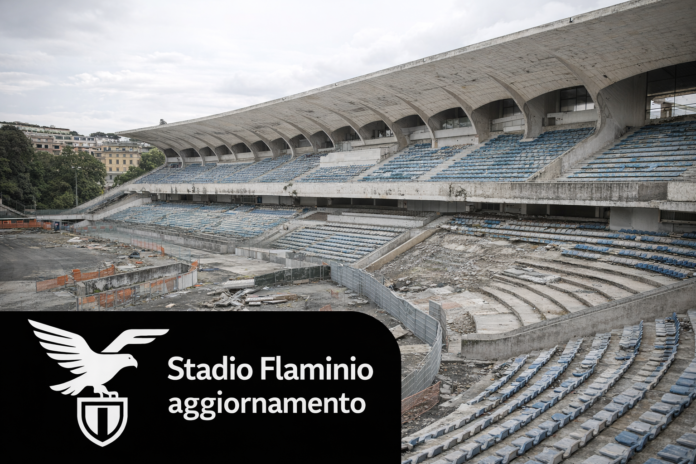

The discussion on the future of the Stadio Flaminio returns forcefully to the centre of attention thanks to the words of architect Lorenzo Busnengo, vice-president of the Ordine degli Architetti di Roma e provincia (Order of Architects of Rome and Province). His assessments, expressed in an official note and picked up by several newspapers, represent a clear stance: Lazio's project for the redevelopment of the Flaminio is not compatible with the regulatory framework and the protections that apply to the stadium.
🧱 A modern monument under protection
Busnengo recalls that the Flaminio, designed by Pier Luigi Nervi, is a true monument of modern architecture, subject to stringent constraints:
Architectural constraint: the stadium is protected by the Code of Cultural Heritage.
Landscape constraint: the entire Flaminio quadrant is subject to specific protections.
Archaeological constraint: a necropolis has been identified in the immediate vicinity, making foundation work complex.
These elements, according to Busnengo, make the transformations envisaged by the Biancoceleste project impossible, or in any case extremely difficult, such as the new ring or the demolition of the roof of the main stand, considered one of the most valuable elements of Nervi's work.
🚧 Why Lazio's project is considered "incompatible"
Busnengo highlights several critical points:
New ring: the structure would be supported by pillars external to the current perimeter, in areas where archaeological finds are practically certain.
Stand roof: its demolition would violate specific constraints and the original design unity.
Current regulations: the current regulatory framework only permits refunctionalisation or philological restoration, not radical transformations.
The judgement of the Ordine degli Architetti is therefore clear: Lazio's project cannot be approved in its current form.
🏗️ Pietralata: a comparison that clarifies the picture
To better understand the complexity of the Flaminio, Busnengo compares the situation with that of Roma's stadium at Pietralata, where the context is completely different:
area free from monumental constraints;
urban transformations already underway;
need for an integrated vision on mobility and complementary works.
The comparison serves to highlight how the Flaminio is not a simple building plot, but an architectural organism to be treated with extreme caution.
📰 Why this news is important
Busnengo's words represent a turning point in the public debate:
they question the feasibility of Lazio's project;
they draw attention to the cultural value of the Flaminio;
they push towards a broader reflection on the future of sports facilities in Rome.
At a time when both Roman clubs are seeking a new home, the voice of the Ordine degli Architetti introduces an element of technical clarity that cannot be ignored.
Full note that appeared on Radio Roma Capitale
"As regards the Stadio Flaminio, however, the project that Lazio has deposited with the Campidoglio presents us with a more complex situation. First of all, it must be said that the stadium designed by Nervi is a monument of modern architecture. We are not faced with a free plot as at Pietralata, but with a monumental architecture protected and constrained under the Code of Cultural Heritage, with an overlapping of protections also due to a landscape constraint that concerns the entire Flaminio quadrant. Without neglecting the archaeological aspect, for a necropolis has been found in the vicinity of the stadium. It is evident in this case that the possibility of transformation as proposed by S.S. Lazio is not compatible with the regulatory framework of protections. Even the intervention to build the new ring appears very complex, because the original design unity of Nervi must somehow be guaranteed. We have read that the new structure will not touch the pre-existing one; indeed, it will be supported by pillars that will be founded outside the current building footprint of the Flaminio in areas where the possibility of archaeological finds is practically certain and on which the Superintendency was very clear already on the occasion of the Roma Nuoto project. Furthermore, to build the second ring, Lazio has planned the demolition of the roof of the main stand, which is one of the most valuable elements of the design unity of the stadium, subject to a series of specific constraints and particular protections, so it is difficult – if not impossible – to envisage its removal. Of course, someone might say that the decrees establishing the constraint can be modified and some flexibility can be found, but with current legislation one can only think of a refunctionalisation or philological restoration, enhancing but without distorting a jewel of Roman architecture recognised worldwide. Despite the press conference presentation and some previews published by some newspapers, we really know very little about Lotito's project, so pending the official publication of the project, as indicated by ANAC already last year, we must reiterate that with these elements available there remain many doubts. The undertaking of expanding the stadium from the current 24,000 to over 50,000 seats appears extremely complex also due to issues linked to mobility, considering that Lazio's proposal envisages, on match days, the transformation of at least that portion of the Flaminio district into a limited traffic zone for about 8 hours (from three hours before to three hours after the match). As already highlighted for the Pietralata project, also for Lazio's proposal it is essential to assess the repercussions of the stadium on the Flaminio quadrant, already so rich in qualifying elements such as the Maxxi, the Auditorium, the future Museo della Scienza, the Villaggio Olimpico, Villa Glori, the Ponte della Musica, and the Lungotevere with the Foro Italico on the other bank. Without forgetting the high residential density in the surroundings of the facility to be redeveloped. Finally, it seems dutiful to us as a professional body to underline that announcements of imminent collapses in analogy with the Ponte Morandi, if not supported by circumstantiated scientific evidence, are merely alarmist, and we would never want certain declarations to have the sole purpose of attempting to consolidate partisan positions."
Link to Radio Roma Capitale post with the full interview: https://www.radioromacapitale.it/articolo/larchitetto-lorenzo-busnengo-vicepresidente-dellordine-degli-architetti-pianificatori-paesaggisti-e-conservatori-di-roma-e-provincia/